
Overview
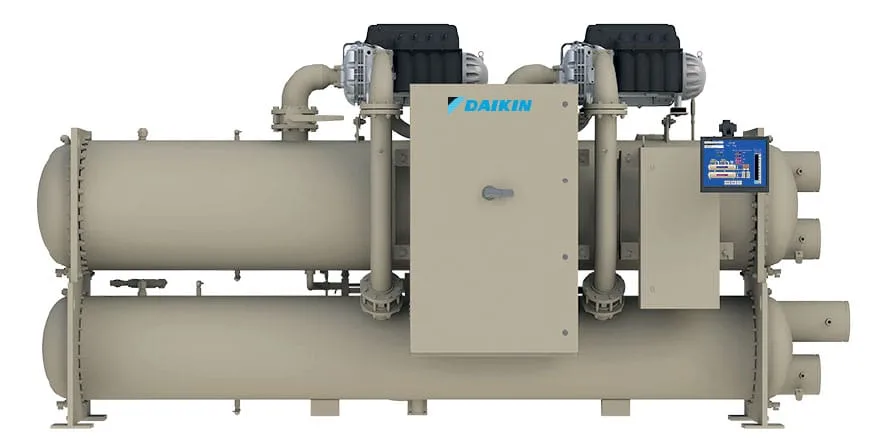
Gayatri Aircon is a commercial chiller supplier and installation contractor serving hospitals, educational campuses, industrial plants and large commercial facilities across North India. We engineer, install and maintain water-cooled and air-cooled screw and scroll chillers from manufacturers such as Daikin, Blue Star, Carrier, Voltas and York.
When this system is the right choice
Chillers are the right choice for facilities with large cooling loads, typically starting from 80 to 100 TR and extending to several thousand tons. Central chillers distribute chilled water through insulated steel pipes rather than refrigerant lines. This makes chillers the practical solution for multi-building university campuses, large hospital complexes, and industrial production plants where indoor distances are too long for direct expansion refrigerant piping.
Between the two chiller types, water-cooled chillers are the right choice when maximum energy efficiency is required and a reliable source of makeup water is available for cooling towers. Water-cooled screw chillers consume lower electrical power per TR than air-cooled units. Conversely, air-cooled chillers are the right choice when water is scarce, water treatment is difficult, or roof space is open. Air-cooled units eliminate cooling towers, water pumps and chemical water treatment, but consume more power during peak summer when outdoor air temperatures reach 45 degrees Celsius.
How we size and design it
Chiller plant sizing begins with calculating total sensible and latent building heat loads along with any process cooling requirements. We calculate water flow rates in gallons per minute (GPM) or cubic metres per hour based on standard temperature drops, typically entering water at 12 degrees Celsius and leaving water at 7 degrees Celsius. For water-cooled systems, we also size the condenser water circuit to reject heat through cooling towers at approximately 3 GPM per ton of refrigeration.
Typical design mistakes include selecting chillers on nominal capacity without factoring in water fouling factors or high summer ambient air temperatures. For air-cooled units, if outdoor ambient temperature rises from 35 degrees to 46 degrees Celsius, chiller capacity drops while power input increases. We size compressors and heat exchangers to deliver required tonnage at peak local summer conditions. Another frequent error is improper primary-secondary pumping design, which causes low delta-T syndrome where chillers run inefficiently because returning chilled water is too cold.
Installation details that matter
Chiller plant installation requires solid civil foundations. Water-cooled chillers are mounted on reinforced concrete inertia bases with heavy-duty spring vibration isolators to prevent mechanical vibration from transmitting into the building frame. Chilled water piping is fabricated from heavy-gauge mild steel (IS 1239 or IS 3589 Class B/C) with welded flanges, butterfly valves, non-return valves, and balancing valves on every circuit.
All chilled water pipes are insulated with closed-cell elastomeric nitrile rubber or polyurethane foam protected by factory-applied aluminum cladding to prevent air contact and condensation. Condenser and chilled water piping must undergo hydrostatic pressure testing at 1.5 times operating pressure for 24 hours. The installation must also include pot feeders for chemical corrosion inhibitors, air separators, and expansion tanks to accommodate water volume expansion during seasonal temperature shifts.
Maintenance
Routine monthly maintenance includes logging entering and leaving water temperatures, oil levels, refrigerant pressures, and compressor motor operating currents. Technicians monitor the approach temperature, which is the difference between leaving water temperature and refrigerant evaporating or condensing temperature. An increasing approach temperature indicates scale or fouling inside heat exchanger tubes.
Water-cooled condenser tubes require periodic mechanical tube brushing or chemical descaling every six to twelve months, depending on cooling tower water hardness. Air-cooled condenser coils require regular cleaning with low-pressure water and alkaline coil cleaners. Common early failures include dirty water strainers causing low flow trips, failed water flow switches causing freeze-up alarms, and oil separator heater failures.
Where it is used
Multi-specialty hospitals, university campuses, pharmaceutical manufacturing cleanrooms, data centers, and heavy manufacturing plants.
What our scope includes
- Energy-efficient step and continuous slide valve capacity control (25% to 100%)
- Hydronic primary and variable secondary pumping circuits for lowest pumping energy
- Induced draft counter-flow FRP cooling towers with low drift loss
- Microprocessor controller with building management system (BMS) integration
- Full vibration isolation and acoustic acoustic enclosure options
- Air-cooled and water-cooled chillers from Voltas, Daikin, Carrier, Blue Star and Hitachi with modular, compact designs
Typical technical data
| Cooling Capacity Range | 50 TR to 1000+ TR single/modular circuits |
|---|---|
| Compressor Types | Semi-hermetic twin-screw and tandem scroll |
| Refrigerant Options | R-134a / R-410A / R-513A low GWP |
| Chilled Water Supply Temp | 6.7 to 7.2 Degree Celsius standard |
| Heat Exchanger | Flooded Shell & Tube evaporator with high-conductivity copper tubes |
| Part-Load Efficiency (IPLV) | Exceeds 7.5 under standard ARI conditions |
Figures are typical ranges for equipment we supply. Final selection depends on the heat load calculation and the manufacturer's data for the chosen model.
How we execute it
Survey and heat load
Site measurements and a room-wise load calculation.
Selection and BOQ
Equipment choice, layouts and itemised bill of quantities.
Installation
Equipment, piping, ducting, drains, electrical and controls.
Testing
Pressure test, vacuum, air balancing and performance readings.
Handover
Commissioning report, as-built drawings and operator training.
Maintenance
AMC with scheduled visits and breakdown support.
Frequently asked questions
What is the main difference between air-cooled and water-cooled chillers?
Air-cooled chillers reject heat directly to outdoor air through aluminum fin coils and propeller fans, requiring no water supply. Water-cooled chillers reject heat into a circulating water loop connected to an outdoor cooling tower. Water-cooled chillers are more energy efficient per TR, but air-cooled chillers avoid cooling tower maintenance and water treatment.
How much power does a commercial water-cooled chiller consume per TR?
A modern water-cooled screw chiller typically consumes between 0.60 and 0.75 kW per ton of refrigeration under full load conditions, and even less under part-load with variable speed drives. An air-cooled chiller typically consumes between 1.10 and 1.30 kW per ton under high summer ambient temperatures.
Why does a central chiller trip on high discharge pressure in summer?
In water-cooled chillers, high discharge pressure trips usually happen because of hard water scale buildup inside condenser tubes, choked cooling tower nozzles, or low condenser water flow. In air-cooled chillers, trips occur when outdoor condenser coils are clogged with dust or when hot discharge air recirculates in tight parapet spaces.
Can chillers provide process cooling for manufacturing machinery?
Yes. Chillers are commonly installed to cool plastic injection moulding machines, pharmaceutical chemical reactors, packaging lines, and printing rollers. Process chillers operate year-round under variable heat loads and require dedicated heat exchangers and storage tanks, which Gayatri Aircon supplies as a chiller supplier and installation contractor.
What chemical treatment is required for chiller water circuits?
Closed chilled water circuits require corrosion inhibitors and biocides to protect steel piping from rusting. Open cooling tower circuits on water-cooled chillers require continuous scale inhibitors, anti-algae biocides, and controlled blowdown to keep dissolved mineral levels within acceptable limits and prevent hard scale on tube walls.
How much clearance is needed in a central chiller plant room?
A central plant room must provide clear floor space equal to the full length of the chiller shell at one end. This clearance is required for technicians to remove end water boxes and insert mechanical cleaning rods through the evaporator and condenser copper tubes during annual descaling and inspection.