Overview
Gayatri Aircon is a specialized cleanroom HVAC service provider engineering and commissioning turnkey controlled environment facilities across India. We deliver certified cleanrooms compliant with ISO 14644-1 (Classes 5, 6, 7 and 8), EU GMP (Grades A, B, C and D), and US FDA standards for pharmaceutical formulations, biotechnology research, sterile medical device manufacturing, and semiconductor assembly.
Cleanroom HVAC principles & environmental control
Cleanroom air conditioning requires far more rigorous controls than standard commercial HVAC:
- Particulate Contamination Control: Multi-stage filtration utilizing primary EU4 pre-filters, secondary EU9 micro-fine filters, and terminal H14 HEPA filters (99.997% efficiency at 0.3 microns) to maintain specified airborne particle concentrations per cubic metre.
- Differential Pressure Cascades: Positive pressure regimes (+10 to +15 Pascals) between clean processing suites, airlocks, and external corridors prevent airborne cross-contamination when doors open. For hazardous oncology or bio-safety facilities, negative pressure suites prevent hazardous active compounds from escaping into surrounding areas.
- Precision Temperature & Humidity Regulation: Temperature maintained at 20°C ± 2°C with tight relative humidity (RH) control between 45% and 55% using modulating chilled water coils, electric reheat banks, and desiccant dehumidifiers for hygroscopic powder handling.
- Laminar & Turbulent Airflow Dynamics: Unidirectional laminar airflow (0.45 m/s ± 20%) over critical sterile filling zones and turbulent dilution airflow in secondary processing areas.
Modular cleanroom panelling and hygienic ductwork
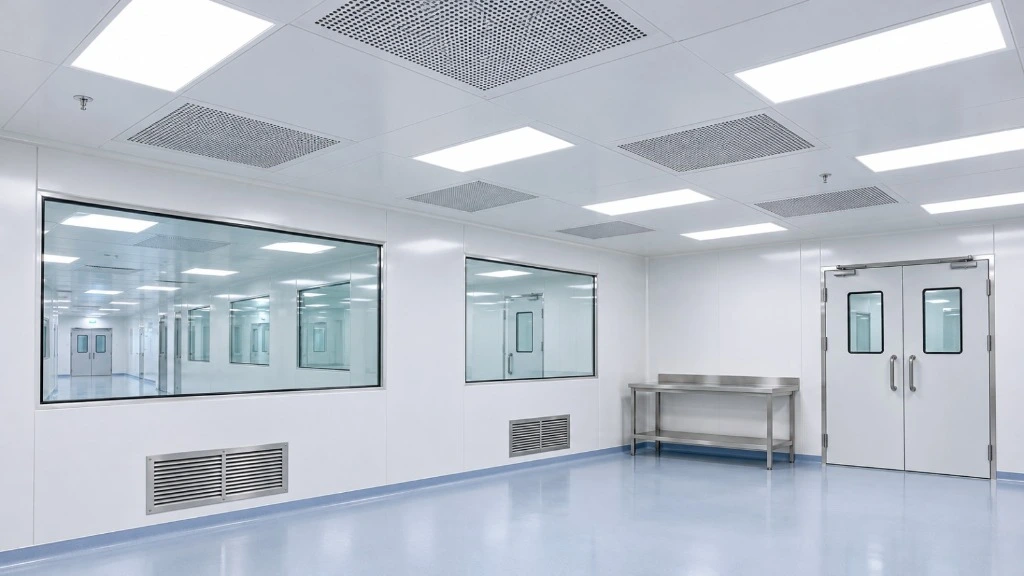
Our turnkey execution encompasses modular double-skin cleanroom wall and ceiling panels, flush silicone covings, Magnehelic differential pressure gauges across every doorway, factory-sealed stainless steel (SS 304) and GI ductwork with antimicrobial coatings, and flush LED cleanroom luminaires.
Testing, validation and documentation (DQ, IQ, OQ)
Every cleanroom project is delivered with comprehensive validation documentation:
- DOP / PAO HEPA filter integrity leakage testing.
- Non-viable airborne particle counts at rest and in operation.
- Airflow velocity and volume measurement across all terminal HEPA diffusers.
- Room recovery time testing (typically under 15 minutes).
- Room differential pressure cascade validation.
Where it is used
Pharmaceutical Formulations, API Production, Medical Device Manufacturing, Electronics & Micro-Chip Assembly, Food Processing, Biotech Laboratories
What our scope includes
- Turnkey compliance with ISO 14644, EU GMP, WHO and US FDA regulatory standards
- Terminal H14 HEPA filtration modules with integrated aerosol injection and DOP test ports
- Airlock interlock doors and differential pressure transmitters with digital displays
- Precision desiccant and condensing dehumidification for moisture-critical processes
- Comprehensive validation dossier with particle count certificates and calibration records
Typical technical data
| Cleanroom Standards | ISO 14644-1 Classes 5 to 8 / EU GMP Grades A, B, C, D |
|---|---|
| Terminal Filtration | H14 HEPA Filters (99.997% Efficiency at 0.3 Micron) |
| Temperature & Humidity | 20°C ± 2°C and 45% to 55% RH (Precision Dehumidification) |
| Differential Pressure | +10 Pa to +15 Pa Positive Pressure Cascade Control |
| Air Changes | 30 to 60+ Air Changes per Hour (ACH) |
| Validation Protocol | DQ, IQ, OQ Documentation with DOP Filter Integrity Testing |
Figures are typical ranges for equipment we supply. Final selection depends on the heat load calculation and the manufacturer's data for the chosen model.
How we execute it
Survey and heat load
Site measurements and a room-wise load calculation.
Selection and BOQ
Equipment choice, layouts and itemised bill of quantities.
Installation
Equipment, piping, ducting, drains, electrical and controls.
Testing
Pressure test, vacuum, air balancing and performance readings.
Handover
Commissioning report, as-built drawings and operator training.
Maintenance
AMC with scheduled visits and breakdown support.
Frequently asked questions
What is the difference between an ISO Class 7 and ISO Class 8 cleanroom?
An ISO Class 7 cleanroom allows a maximum of 352,000 particles (>= 0.5 micron) per cubic metre of air and typically requires 30 to 60 air changes per hour with terminal HEPA filtration. An ISO Class 8 cleanroom allows up to 3,520,000 particles per cubic metre with 15 to 25 air changes per hour.
How is differential pressure maintained between cleanroom suites?
Differential pressure is created by precisely balancing supply and return air volumes using motorized volume control dampers (VCDs) connected to Magnehelic or digital differential pressure sensors, maintaining higher pressure in cleaner rooms so air always flows outward.
What documentation is provided upon cleanroom HVAC completion?
We provide full validation dossiers including Design Qualification (DQ), Installation Qualification (IQ), and Operational Qualification (OQ) protocols along with third-party calibrated test reports for PAO filter integrity, particle count certifications, and airflow balance.