Overview
Gayatri Aircon is a commercial and industrial mechanical ventilation service provider providing engineering, equipment supply, ductwork fabrication, air balancing and commissioning across North India. We engineer Treated Fresh Air (TFA) systems, industrial plant air ventilation, basement car parking carbon monoxide (CO) exhaust with impulse jet fans, commercial kitchen exhaust, and high-volume air change systems compliant with ISHRAE, ASHRAE 62.1 and NBC standards.
Engineering criteria & ventilation system design
Mechanical ventilation maintains indoor air quality (IAQ), controls humidity, and removes airborne contaminants, heat, and toxic gases:
- Treated Fresh Air (TFA) & Heat Recovery Units (HRV/ERV): Pre-cools and dehumidifies outdoor ambient fresh air using total heat recovery wheels before introducing it into commercial office floors, reducing the electrical load on primary air conditioning plants.
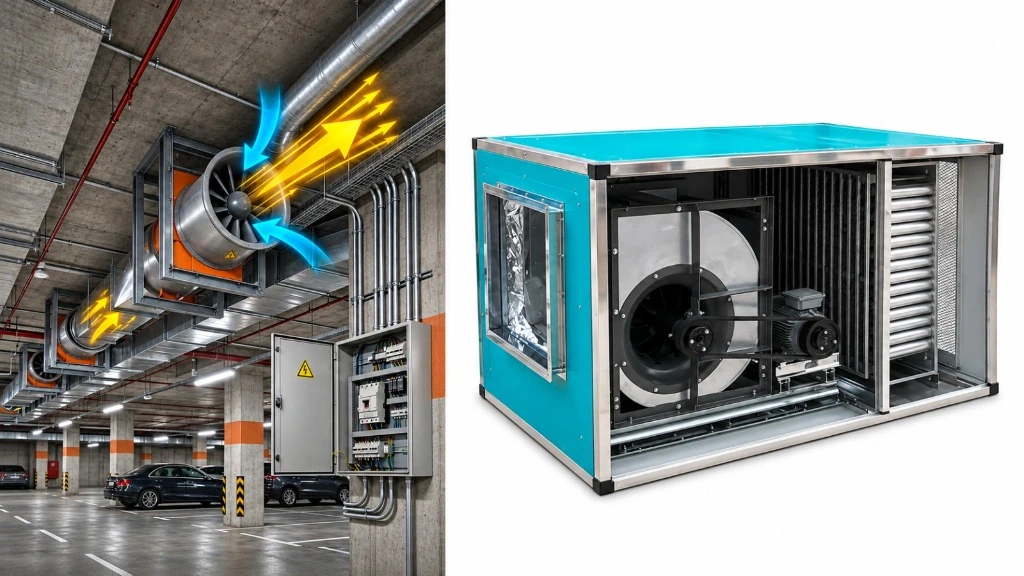
- Basement Car Park Ventilation with Jet Induction Fans: Eliminates complex, bulky duct networks by utilizing high-velocity impulse jet fans to sweep vehicle exhaust fumes and carbon monoxide towards main extract shafts. Integrated with continuous CO monitoring sensors that ramp up fan speeds via VFDs on demand.
- Commercial Kitchen Exhaust & Ecology Units: High-static kitchen hoods with baffle grease filters, heavy-gauge welded mild steel ducting, and electrostatic precipitators (ESP) with wet scrubber systems to trap grease and smoke before rooftop discharge.
- Industrial Factory & Warehouse Ventilation: High-capacity roof extractors, axial flow wall exhaust fans, and supply air louvers engineered to achieve 15 to 30 air changes per hour (ACH) in high-temperature manufacturing environments.
Ductwork fabrication and installation details
All ventilation ductwork is manufactured from factory-certified galvanized iron (GI) sheets (IS 277 standard with 120 or 275 GSM zinc coating). Ducts are reinforced with angle iron flanges, neoprene gasket sealing to prevent air leakage, and heavy-duty mild steel drop rod hangers. Exhaust fans are isolated with heavy rubber-in-shear or spring vibration isolators and fire-resistant flexible canvas connections.
Commissioning and air balancing
Our commissioning scope includes digital anemometer velocity testing, pitot tube static pressure traverses across duct mains, and smoke testing to verify directional airflow patterns and positive/negative pressure regimes.
Where it is used
Commercial Basements, Factory Floors, Industrial Workshops, Commercial Kitchens, Multiplexes, Data Centers, Parking Garages
What our scope includes
- Treated Fresh Air (TFA) integration reducing HVAC cooling load by up to 25%
- Ductless basement car parking jet fan ventilation with automated CO sensor control
- Heavy-gauge galvanized steel and welded mild steel construction compliant with fire codes
- Dynamically balanced aerofoil impellers for low noise and vibration
- Complete air balancing, duct leakage testing, and air change rate verification
Typical technical data
| Airflow Capacity | 500 CFM to 80,000+ CFM |
|---|---|
| Equipment Scope | TFA Units, Heat Recovery Wheels, Axial Fans, Centrifugal Blowers, Jet Fans |
| Static Pressure | 15 mm to 120 mm Water Gauge (WG) |
| Motor Standard | IE3 Premium Efficiency Flame-Proof / TEFC IP55 Motors |
| Fire Rating | Smoke Spill Fans rated 250°C / 300°C for 2 Hours (Class H) |
| Air Filtration | Washable Aluminum Pre-filters EU4 / MERV 8 with Optional Carbon Filters |
Figures are typical ranges for equipment we supply. Final selection depends on the heat load calculation and the manufacturer's data for the chosen model.
How we execute it
Survey and heat load
Site measurements and a room-wise load calculation.
Selection and BOQ
Equipment choice, layouts and itemised bill of quantities.
Installation
Equipment, piping, ducting, drains, electrical and controls.
Testing
Pressure test, vacuum, air balancing and performance readings.
Handover
Commissioning report, as-built drawings and operator training.
Maintenance
AMC with scheduled visits and breakdown support.
Frequently asked questions
What is the difference between ventilation and air conditioning?
Air conditioning recirculates and cools indoor air to achieve thermal comfort. Ventilation introduces fresh outdoor air to dilute carbon dioxide, odors, and contaminants while exhausting stale, humid air. In high-occupancy commercial and industrial buildings, both systems operate together.
How many air changes per hour (ACH) are required for basement parking ventilation?
Under Indian National Building Code (NBC) and ISHRAE guidelines, commercial basement parking areas require 6 air changes per hour during normal operating hours, increasing to 12 to 15 air changes per hour during emergency fire and smoke clearing mode.
What is a Treated Fresh Air (TFA) unit and why is it needed?
A Treated Fresh Air unit conditions outdoor fresh air by passing it through cooling coils and filters before delivering it into an air-conditioned building. This prevents hot, humid outdoor air from overwhelming indoor room temperature and humidity control.