Overview
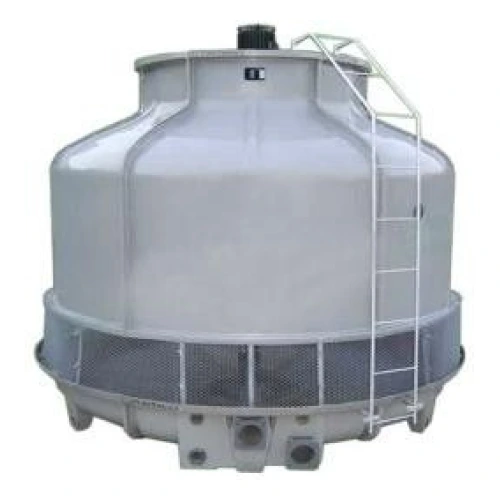
Gayatri Aircon is an industrial cooling tower supplier, piping service provider and maintenance specialist serving central chiller plants, manufacturing facilities, chemical plants and commercial developments across North India. We engineer, supply, erect and maintain bottle-type round counterflow and square crossflow FRP cooling towers ranging from 10 TR to over 1500 TR.
When this system is the right choice
A cooling tower is an indispensable component of any water-cooled central chiller plant or water-cooled process heat exchanger. Water-cooled chillers reject condenser heat into a recirculating water circuit, and the cooling tower transfers that heat into the ambient atmosphere through evaporative heat exchange.
Water-cooled chiller plants with high-efficiency cooling towers achieve the lowest kW per TR electrical consumption among all commercial HVAC architectures. They are commonly used for multi-story hospitals, pharmaceutical cleanrooms, automotive manufacturing plants, data centres, shopping malls and university campuses where high continuous cooling loads justify dedicated plant room infrastructure and water supply.
Sizing and engineering criteria
Cooling tower sizing depends strictly on local outdoor wet-bulb design temperatures rather than dry-bulb ambient temperatures. In North India during peak summer and humid monsoon months, the design wet-bulb reaches 28°C to 29°C. Cooling towers must be engineered with an approach temperature of 3°C to 4°C above wet-bulb, ensuring cooling water supply at 32°C returning to chillers at 37°C under full load.
We calculate required water circulation flow at 3.0 to 4.0 GPM per ton of refrigeration (approx. 0.68 to 0.91 m³/hr per TR). Our engineering covers FRP casing thickness, aerofoil fan static pressure for optimal air velocity across PVC honeycomb fills, non-clog rotating sprinkler or target nozzle distribution, and automatic chemical bleed-off to maintain optimal Total Dissolved Solids (TDS).
Installation and piping details
Our turnkey scope includes structural steel base elevation to facilitate positive suction head for condenser pumps, vibration isolation, Class C heavy-gauge mild steel or hot-dip galvanized header piping, butterfly isolation valves, dual suction strainers, and non-slam check valves. All piping undergoes 24-hour hydrostatic pressure testing at 1.5 times working pressure.
Preventive maintenance and water treatment
To prevent scale formation on chiller condenser tubes and protect tower fill packs from biological slime, we implement automated chemical dosing and scheduled blowdown. Preventive maintenance covers monthly dynamic fan balancing, motor winding insulation checks, nozzle flushing, drift eliminator cleaning, and bi-annual basin draining, disinfection, and chemical descaling.
Where it is used
Central Chiller Plants, Commercial Complexes, Chemical Processing, Manufacturing Industries, Hospitals, District Cooling
What our scope includes
- High-efficiency evaporative heat rejection with low approach temperature (3°C to 4°C)
- Corrosion-proof fiberglass reinforced plastic construction designed for 15+ years outdoor life
- Low noise aerofoil cast aluminum fan blades directly driven or belt-driven with weather protection
- Uniform water distribution through rotary sprinkler heads or non-clogging target spray nozzles
- Virgin thermoformed PVC fills with honeycomb flutes and integrated drift eliminator louvers
- Heavy-duty FRP basin sump with built-in suction strainer and quick-clean drain port
Typical technical data
| Cooling Capacity | 10 TR to 1500+ TR |
|---|---|
| Tower Types | FRP Induced Draft Round Bottle / Square Cross Flow |
| Casing Material | FRP (Fiberglass Reinforced Plastic) with UV-stabilized gel coat |
| Fan & Motor | Aerofoil aluminum / FRP fan with IP55 weather-proof TEFC motor |
| Fill Media | Virgin PVC honeycomb fills with integral drift eliminators |
| Basin & Piping | Heavy-duty FRP sump basin with auto-float valve, drain and overflow |
| Water Flow Rate | 3.0 to 4.0 GPM / TR (0.68 to 0.91 CMH / TR) |
| Trade Scope | Authorised Channel Partner, Wholesaler, Service Provider & AMC |
Figures are typical ranges for equipment we supply. Final selection depends on the heat load calculation and the manufacturer's data for the chosen model.
How we execute it
Survey and heat load
Site measurements and a room-wise load calculation.
Selection and BOQ
Equipment choice, layouts and itemised bill of quantities.
Installation
Equipment, piping, ducting, drains, electrical and controls.
Testing
Pressure test, vacuum, air balancing and performance readings.
Handover
Commissioning report, as-built drawings and operator training.
Maintenance
AMC with scheduled visits and breakdown support.
Frequently asked questions
What is the role of a cooling tower in a central HVAC plant?
A cooling tower rejects the heat absorbed by a water-cooled chiller into the atmosphere through evaporative cooling. Warm condenser water from the chiller is pumped to the cooling tower, sprayed over PVC fills, cooled by ambient air drawn by a fan, and recirculated back to the chiller condenser at 32°C.
How much water does an industrial cooling tower consume?
An evaporative cooling tower evaporates roughly 1% to 1.5% of its circulating water volume to provide cooling, plus small losses from drift and blowdown. For a 100 TR chiller under peak summer conditions, makeup water requirement typically averages 800 to 1200 litres per operating hour.
What types of cooling towers does Gayatri Aircon supply and install?
We supply, install and service round bottle-type counterflow FRP cooling towers, square crossflow FRP cooling towers, and multi-cell modular industrial cooling towers with capacities from 10 TR to over 1500 TR.
Why is cooling tower water treatment and blowdown necessary?
When water evaporates in a cooling tower, minerals like calcium and silica stay behind, increasing the mineral concentration (TDS). Without controlled blowdown and water treatment chemicals, scale deposits coat the chiller condenser tubes, dramatically increasing power consumption and triggering high-pressure compressor trips.
How often should cooling tower fills and nozzles be serviced?
Spray nozzles should be inspected monthly to ensure uniform water coverage. PVC fill packs should be chemically flushed every six months to clear algae and silt. In areas with hard water, periodic descaling prevents calcified deposits from restricting airflow.